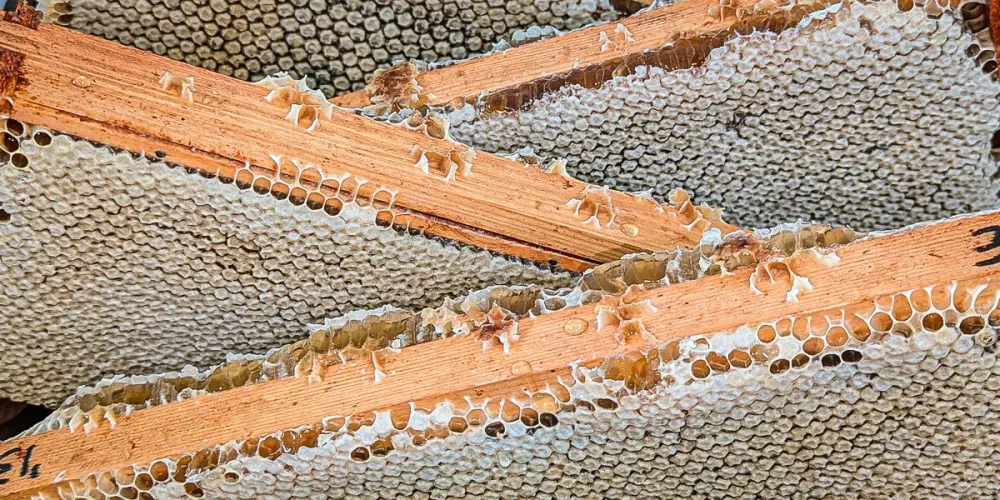
Prizewinning local honey from the Scottish Borders.
I keep bees in the Scottish Borders, on the rolling western slopes of the Cheviots, and the rich river valleys of the Tweed and the Teviot. If the weather behaves, there are distinct spring and summer honey crops, plus some late-season heather if it stays warm and dry through August and early September.
The bees forage widely on the rich agricultural land in valleys, and the scrubby woodland and grazing in the surrounding pastures. Forage is mixed, ranging from early season willow, oil seed rape and dandelion to the later flowering field beans, blackberry, and clover. There are also a great range of tree nectars available during the season including hawthorn, sycamore, and lime.
My apiaries are small, and the honey is extracted separately. The distinct and unique flavours reflect the nectars available within 1–2 km, the range over which bees forage.
Spring honey is usually high in glucose and, without suitable preparation, tends to crystallise quickly. I therefore warm it gently and seed it with a small amount of fine textured set honey before allowing it to recrystallise. This produces what is sometimes called ‘creamed’ or ‘soft set’ honey, with a lovely ‘melt on the tongue’ texture. It is spoonable but not clear. It has a long shelf life but rarely lasts that long.
Summer honey is a clear, golden, runny honey. Over time this honey will crystallise. Crystallisation is generally a sign of high quality honey and is rarely seen in the supermarket ultrafiltered and pasteurised honeys labelled ‘Produce of EU and non-EU countries’ (which, of course, means ‘anywhere’). This filtration removes almost all the pollen. In contrast, high quality honey contains a lot of residual pollen around which the crystals form. The crystallisation will not affect the excellent flavour of the honey, and can be reversed by gently warming the jar until the crystals disappear. However, most jars are finished long before there is any sign of crystallisation.
My spring (soft set) and summer (clear) honey were both placed first in the relevant class in the 2025 Border Beekeepers Honey Show.
In good seasons I also produce limited amounts of heather honey. Some is jarred and sold as pure heather honey, with the remainder being mixed with spring honey to make a delicious, and popular, blended honey.
My honey is usually sold by select café’s, farm shops and other artisinal outlets that specialise in high quality local produce.